Achieve Faster Product Cycles in Retail with AI-Driven Engineering

Key Takeaways:

  • Retailers using AI have cut launch timelines by 30% and boosted revenue by 85%.
  • AI-powered engineering eliminates delays from planning to launch.
  • Retailers that react in real time win in trend-driven markets.
  • Digital twins are replacing costly physical prototyping of products.

The Retail Race Is On

Customer expectations in retail are evolving by the hour. Product cycles are tighter than ever, resources are stretched, and the margin for error keeps shrinking. Nearly 75% of consumers now expect personalized experiences, and they will turn to competitors if brands don’t catch up.

Continue reading “Achieve Faster Product Cycles in Retail with AI-Driven Engineering”

6 Key Challenges in AI Engineering and How to Overcome Them

Key Takeaways:

  • The fast pace of AI development makes deployment challenging
  • AI use must be innovative and support human endeavor ethically
  • High-quality data collection at scale is vital for success
  • Working with an expert AI partner can help navigate issues

6 Key Challenges in AI Engineering and How to Overcome Them

New AI developments are coming on stream all the time, as the world continues to appreciate just how much of a difference the technology can make. It can enhance research and development, analyze data at greater speed and scale, augment human endeavor and automate routine tasks, to name just a few of its typical everyday use cases.

However, as with any emerging technology, there are practical barriers to overcome in order to maximize the potential of the innovation. This blog will explore the six biggest challenges to overcome in AI engineering, and how this can be achieved.

What Are the Biggest Challenges in AI Development Today?

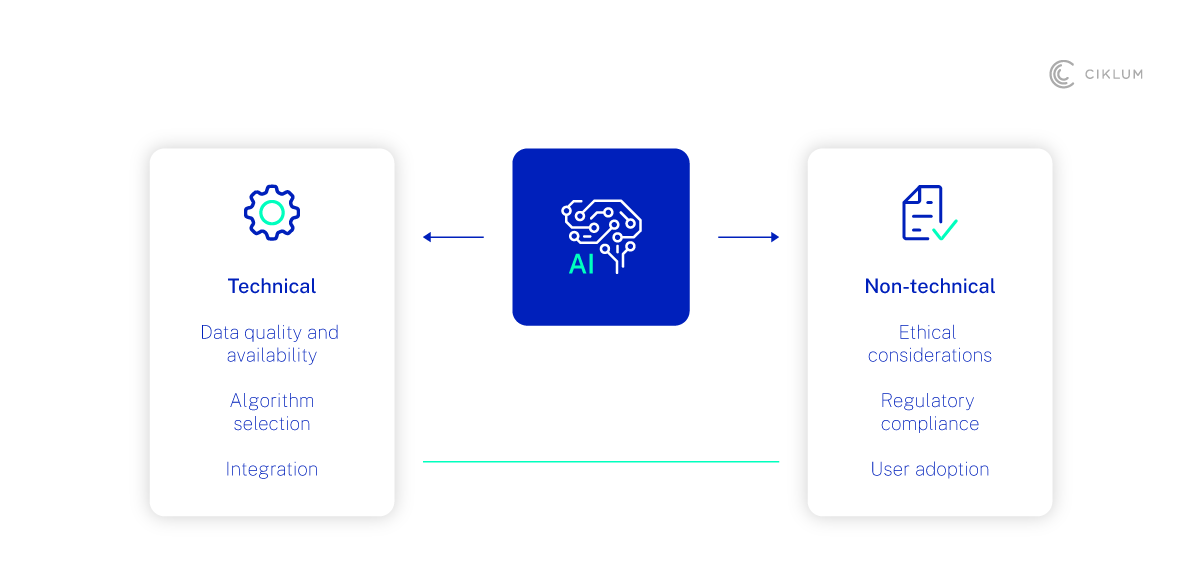
1: Data-Related Challenges

The output of AI is only as good as the input: that is to say that the quality and quantity of data fed into the AI tool need to be as high as possible to deliver the best possible results. To enable this, it’s important to establish data augmentation techniques and robust data pipelines, so that datasets can generate the most relevant, accurate results possible.

These solutions can also extend into areas such as transfer learning (where machine learning models trained on one task are fine-tuned to be used on another), and synthetic data generation (artificial data that mimics real-life equivalents to simulate patterns and AI algorithms).

2: Legacy System Integration

According to Forbes, as many as two-thirds of businesses are still using mainframe or legacy applications for their core business operations. This use of increasingly outdated technology means their ability to integrate AI is severely impaired, particularly when it comes to solution compatibility, data silos and future scalability.

The most practical way to navigate this issue is to use middleware as a bridge between old and new. These robust connectors enable legacy systems to integrate with AI tools and enable AI insights and efficiencies to be enjoyed across a network – without the cost and disruption of a large-scale system overhaul.
graph1-Oct-09-2024-08-54-49-1814-AM

Continue reading “6 Key Challenges in AI Engineering and How to Overcome Them”

AI Predictions 2025: Big Tech Investments Accelerating Innovation

Key Takeaways:

  1. AI’s existing use cases continue to expand
  2. Retail, finance and healthcare are all being transformed
  3. Edge computing and robotics lead new AI innovations
  4. Global collaboration is needed to support a better society

AI Predictions 2025: Big Tech Investments Accelerating Innovation

Almost everywhere you look, a major industry is being reshaped and transformed by artificial intelligence. This includes generative AI and natural language models facilitating easier communication; predictive analytics adding context and personalization to customer service; and algorithms supporting informed, data-driven marketing.

Continue reading “AI Predictions 2025: Big Tech Investments Accelerating Innovation”

GenAI and the Payments Lifecycle: Innovative Strategies for the Future

Key Takeaways:

  1. GenAI is relevant for both service providers and end users
  2. GenAI drives scalability and efficiency
  3. GenAI has massive self-improvement and integration capabilities

Introduction

The digital payments lifecycle has evolved significantly since its inception, with total transaction value expected to reach USD 17.72 trillion in 2024 according to Statista. This has partly been made possible by a constant evolution in various technologies, such as data encryption, biometric authentication, magnetic secure transmission, near-field communication, blockchain, artificial intelligence and machine learning. 

Continue reading “GenAI and the Payments Lifecycle: Innovative Strategies for the Future”

AI Agents Explained: The Future of Task Automation and Productivity

Key Takeaways:

  1. AI agents massively expand the potential of automation
  2. Complex business processes can be dealt with without manual intervention
  3. New levels of efficiency, productivity, accuracy and informed decision-making
  4. Striking the balance between AI abilities and human creativity is vital

AI Agents Explained: The Future of Task Automation and Productivity

Artificial intelligence (AI) agents are programs that can perform tasks and achieve pre-defined goals through interactions with the environment around them and collecting data. They use algorithms and data input to process information using machine learning models, react to variables and circumstances, and work towards human-set objectives.

Continue reading “AI Agents Explained: The Future of Task Automation and Productivity”

Banking Experience 2025: Trends Shaping Customer Expectations

Banking Experience 2025: Trends Shaping Customer Expectations

All over the world, traditional banking models are being disrupted by changing customer experience expectations. For example, by 2028, nearly 80 million Americans are expected to be using digital banking services – that’s nearly a quarter of the entire population.

Continue reading “Banking Experience 2025: Trends Shaping Customer Expectations”

The Increasing Role of Virtual Assistants and Chatbots in Revolutionizing Automotive Industry

As the automotive industry embraces digital transformation, the demand for seamless, efficient, and personalized customer interactions has never been higher. AI-driven virtual assistants and chatbots are redefining how businesses connect with their customers. From answering inquiries about new and used cars to streamlining service bookings, these technologies are transforming the customer journey. 

Continue reading “The Increasing Role of Virtual Assistants and Chatbots in Revolutionizing Automotive Industry”

Big Tech’s $200 Billion AI Bet – Growth or Gamble?

As Big Tech dives deeper into artificial intelligence, Microsoft, Meta, Amazon, and Alphabet are collectively expected to surpass $200 billion in capital investment this year. These expenditures are primarily focused on data centers and AI-driven tools. While these tech giants tout AI’s potential to enhance services and cut costs, Wall Street is skeptical about whether the returns will justify such massive spending.

Continue reading “Big Tech’s $200 Billion AI Bet – Growth or Gamble?”

Understanding LLM Agents: Types and Applications in AI

Key Takeaways:

  • LLM agents deliver contextual content in a range of applications
  • They can support interaction, collaboration and analytical insights
  • Retail and education are two sectors already making full use of the technology
  • Ethical use is vital, especially as the technology advances

Understanding LLM Agents: Types and Applications in AI

Large Language Models have formed one of the cornerstones of artificial intelligence growth in recent years, thanks to their ability to generate written content that’s detailed, contextual and relevant to the user’s needs. With 67% of businesses prioritizing LLM adoption by year-end, LLM agents are proving to be particularly useful, from creating project plans and writing code to summarizing meetings and supporting research.

Continue reading “Understanding LLM Agents: Types and Applications in AI”

Anthropic Unveils AI Models to Automate Complex Tasks, Marking a New Era for AI Agents

Anthropic, an AI startup backed by tech giants Alphabet and Amazon, has recently introduced an innovative feature within its updated artificial intelligence models. This new development brings the concept of autonomous agents to the forefront, with AI now capable of performing complex computer tasks such as moving the mouse, clicking, and typing – essentially automating interactions typically reserved for human users. This breakthrough represents a major step in the evolution of AI models beyond traditional chatbots, setting the stage for more sophisticated applications in industries from software development to education.

Continue reading “Anthropic Unveils AI Models to Automate Complex Tasks, Marking a New Era for AI Agents”