



Continue reading “How to Improve Quality Assurance In Banking & Financial Applications”
The rapid expansion of artificial intelligence in the world of business means it’s now starting to become a mainstream activity. According to IBM, 42% of IT professionals in large organizations report to have deployed AI within their operations, while another 40% are actively exploring their own opportunities to do so.

But amid the gold rush to get on board with AI technology, it’s important to understand the different types of AI tools out there, what they do, and the key differences between them. This blog explores the distinctions between two of the most popular forms around: Conversational AI and Generative AI, and how to work out where you should apply them to your business activities.
Conversational AI refers to technology that can understand, process and reply to human language, in forms that mimic the natural ways in which we all talk, listen, read and write. Generative AI, on the other hand, is the technology that can create content based on user prompts, such as written text, audio, still images and videos.
Aside from the functionality that they offer, there are several key differences between the two. For example, Conversational AI relies on language-based data and user interactions, whereas Generative AI can use these datasets and many others when creating content. However, there is some scope for overlap between the two, such as when text-based Generative AI is used to enhance Conversational AI services.
There’s also plenty of variation between the main suppliers of each technology, and the costs involved. Conversational AI features many of the big tech players through Virtual Assistants: think Google Assistant, Amazon’s Alexa and IBM Watson; however, a number of smaller players like Kore.ai are making waves, too. As for Generative AI, many new businesses have made real headway in gaining market share, such as OpenAI with its Artificial Intelligence application ChatGPT. But even Generative AI is becoming increasingly centred around Big Tech, particularly when it comes to infrastructure models.
There is a wide range of industries that are already benefiting from Conversational AI implementation, including (but not limited to):
 Data collection:
Conversational AI can help gather important data from several sources and collate it for driving meaningful and digestible insights to guide data-driven AI decision-making.
 Customer support:
Responses to the most common queries and issues can be automated by chatbots, freeing up service agent time to deal with more complex cases.
 E-commerce:
Feeding personalized recommendations to customers to encourage them to purchase, as well as supporting order management when customers look for information.
 Healthcare:
Preliminary diagnoses for common ailments can be taken care of by virtual healthcare platforms, which can also support the management of appointment scheduling.
 Banking:
The process of conducting financial transactions and dispensing financial advice can be eased through Conversational AI.
 Human resources:
Many of the important but relatively straightforward HR functions can be covered by Conversational AI, such as onboarding processes, recruitment procedures and employee support.
The use cases for Generative AI tend to be very different to its conversational counterpart, but they’re no less valuable, such as:
 Business process automation:
Repetitive tasks and processes can be intelligently automated, as Generative AI can extract the key data required and complete the process independently.
 Content creation:
Every type of organization can benefit from creating marketing copy or writing blog articles with some assistance from Generative AI.
 Media:
Similarly, Generative AI can be used to create images, logos, videos and other visual promotional content.
 Software development:
Snippets of code can be generated to expedite development processes, while Generative AI can also assist in software debugging.
 Education:
Personalized learning experiences can be supported through the generation of educational materials.
 Finance:
Generative AI can also understand patterns of human activity, helping finance firms with fraud detection, especially when combining Generative AI with existing Machine Learning classification problems to boost the performance of both technologies.
 R&D:
R&D:
The ability to analyze and process data at scale to create hypotheses can be helpful in assisting scientific research.
The business AI solutions landscape is complex, and it’s evolving at a rapid rate. Not only that, but the global AI marketplace is saturated, meaning that it can be hard to know how to get started with what is a very important investment for your organization.
The key is to establish a comprehensive, agile strategy for AI, and that begins by understanding where you can apply Conversational AI vs Generative AI. The following five steps are a good place to start:
Drive forward AI-powered creativity by partnering with pioneers with proven success. Explore Ciklum’s Experience Engineering approach to fast and iterative development, alongside end-to-end strategy and execution, here.
In a highly competitive and globalized business world, every organization needs full confidence that their new products are going to be successful. A big part of that comes from understanding customer needs and preferences and developing products that solve well-defined consumer problems.
Ideally, no organization should commit valuable time, money and resources to development without having that understanding in place – and the best way to get it is through product discovery. This blog explores product discovery in detail, including how it’s driving tech innovation for businesses like yours.
Product Discovery is an approach that ensures customer insights are integrated into every stage of the product development process. It’s achieved through collating detailed research, user feedback and market trends, to give product teams a comprehensive understanding of what their target customers need, want and prefer.
Having clear product discovery frameworks is vitally important in product development, as it substantially reduces the risk of mistakes being made – and resources being wasted – by chasing assumptions and ideas that haven’t been validated.
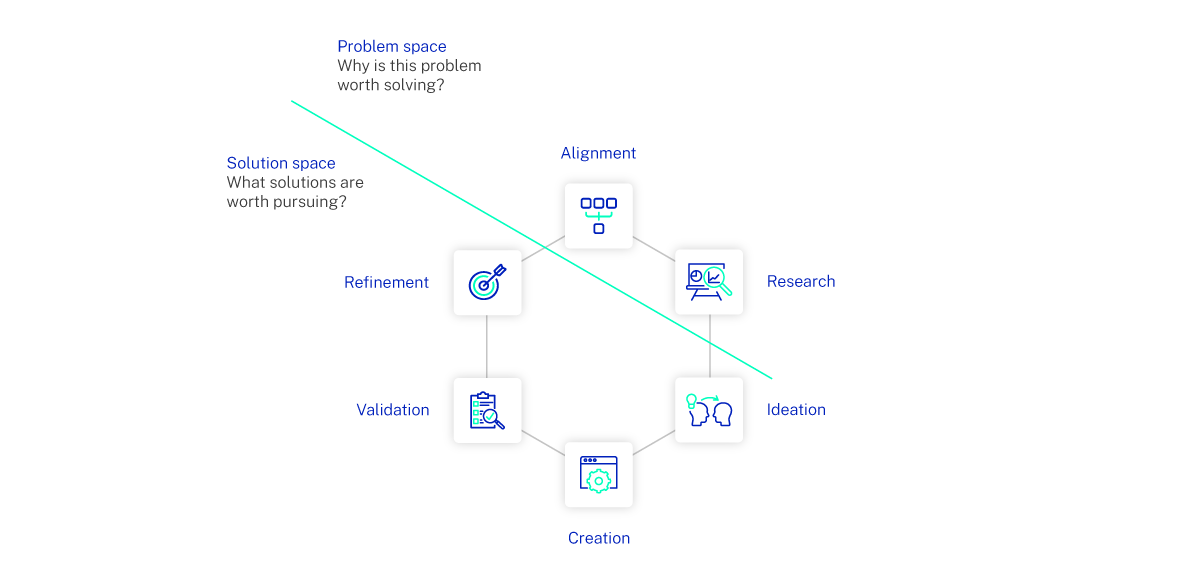
Identifying market opportunities and user pain points through product discovery techniques sets the stage for successful product development, supporting areas such as:
 Identifying Customer Needs
By exploring the unmet needs and pain points of customers, solutions can better address real-world problems, create value and build relationships; this should ideally be done through face-to-face user research with the end customer.
 Fostering Creativity
Brainstorming, workshops and an open-ended approach to exploration allow existing assumptions to be challenged, so that product teams think more creatively. This should be as inclusive as possible and include engineers, designers, sales and marketing practitioners, customers and all other relevant stakeholders.
 Enabling Real-World Validation
Testing early versions and prototypes of products can help refine ideas based on real user feedback, spot potential issues early on, and gain validation for the concept in a low-cost, low-risk environment.
 Reducing Risk
Connected to the previous point, the uncertainty around development can be removed by validating pricing strategies, product positioning and market demand as early as possible; this can also help achieve internal buy-in for the project.
 Refining Solutions
Product discovery supports continuous improvement through building, testing and enhancement that’s based on user feedback and insights. This allows products to be refined and optimized towards user needs quickly and accurately.
 Supporting Data-Driven Decision-Making
Collecting market research, user feedback and product usage data is vital for gaining the insights that support the right decisions, in turn ensuring that products are built on facts rather than guesswork.
 Encouraging Collaboration
The product discovery process naturally brings together diverse perspectives and fosters a culture of knowledge sharing across every team and function. This can be instrumental in driving forward customer needs, technical feasibility, and business viability.
 Maximizing Agility
By encouraging high user interaction through continuous product discovery, it becomes easier to adapt to evolving market dynamics and understand when and where to take advantage of improvement opportunities over time. Not only can this support product development, but the insights involved can improve marketing and the wider business strategy, too.
 Enhancing User Experiences
By bringing users more directly into the development process and gathering their feedback, the overall user experience of the product can be better refined and give them the outcomes they’re looking for.
 Driving Competitive Advantage
Being in a better position to embrace new opportunities and innovative ideas provides a solid platform for delivering new solutions, functions and features before competitors are able to.
As demonstrated, effective technological innovation can only stem from a deep understanding of user needs and pain points. At Ciklum, we’ve harnessed the power of product discovery with our unique Experience Engineering approach to drive technological advancements that address real-world challenges across various industries.
The Ciklum team were recently tasked with enhancing a learning management system for a large network of private schools, focusing on improving parents’ experiences. During the product discovery phase, we identified two critical issues. First, parents were managing up to 17 different logins to access various services and information. Second, user testing revealed that a significant number of parents were navigating straight from the homepage to the calendar to find timetable notifications.
To resolve these issues, we implemented two key solutions. We redesigned the product to incorporate the calendar directly into the homepage, streamlining the user experience and allowing parents to access crucial information at first glance. Then, leveraging our advanced artificial intelligence (AI) expertise, we integrated a large language model chatbot. This feature enables parents with varying technical skills to interact with the platform using natural language, significantly enhancing accessibility and user engagement.
Some of the world’s most well-known technology products have been successful thanks to product discovery. For example, Netflix transitioned from a DVD rental service to a streaming platform after recognizing that customers wanted access to a large amount of content through much easier means. In the business world, the team collaboration tool Slack has gained traction by understanding workplace communication challenges and developing a platform specifically to address those challenges.
So it’s clear that product discovery is vital to drive tech innovation and support business success in the long-term. A good product discovery phase involves focusing on problems, and as an experience engineering company, CikIum’s ability to create, build and scale technology products can help solve those problems. In our extensive experience, we believe there are five key product discovery steps to making it as successful as possible:
Ready to take an expertise and data-driven approach to product discovery? Explore Ciklum’s ability to create, build and scale technology products here.
Continue reading “10 Ways Product Discovery Fuels Tech Innovation”
In a competitive global marketplace, speed has arguably never been more important when it comes to developing new products. This is partly to gain first-mover advantage with new solutions and meet transformation goals, but also to overcome the slow and expensive nature of software development that can hold agility and reactive evolution back.
Continue reading “9 Ways Low Code Applications Are Transforming Businesses”
Have you ever used a piece of software within your business and felt frustrated that it couldn’t do everything you wanted it to do? Or felt that it was a good solution generally but not very well suited to the specifics of your organization? If so, you aren’t alone – and the good news is that there’s a solution at hand.
According to a global survey conducted by McKinsey in 2021, 56% of financial institutions have embraced artificial intelligence (AI) in various operational aspects. This survey has shown a profound evolution within the industry, where AI is increasingly recognized as a catalyst for innovation and efficiency.
Continue reading “Transformative Effects of Artificial Intelligence on Financial Services”
According to World Health Organization (WHO), Medication errors alone cost an estimated US$ 42 billion annually. Unsafe surgical care procedures cause complications in up to 25% of patients resulting in 1 million deaths during or immediately after surgery annually.
Continue reading “Emergence of Virtual Reality (VR) in healthcare”
According to Allied Market Research, Global generative AI in the Healthcare market is projected to experience lucrative growth with a CAGR of 34.9% from 2023 to 2032. Generative AI in Healthcare is expected to reach $30.4B by the end of 2032.
Continue reading “The Role of Generative AI in Shaping the Future of Healthcare”